
MiGreRe - Sustainable recycling of blended yarns and fabrics
It is estimated that less than one percent¹ of all textiles worldwide are recycled into new textiles. Clothing made from cotton-polyester blends, pose a particularly great challenge for recycling.
As the different fibres in blended yarns are tightly intertwined, it is impossible to carry out material-specific separation using methods available today. Consequently, these yarns are often recycled into lower-grade products or incinerated.
The MiGreRe project is developing an innovative recycling process in which textiles are first ground into particles at extremely low temperatures (cryogenically), then electrostatically charged, and finally separated in an electric field.
The aim is to extract singlevariety resources and reuse them to manufacture new, high-quality products such as viscose, lyocell and cellulose acetate, thereby closing the material cycle.
¹ Ellen MacArthur Foundation (2017) – A New Textiles Economy Redesigning (PDF)
The procedure
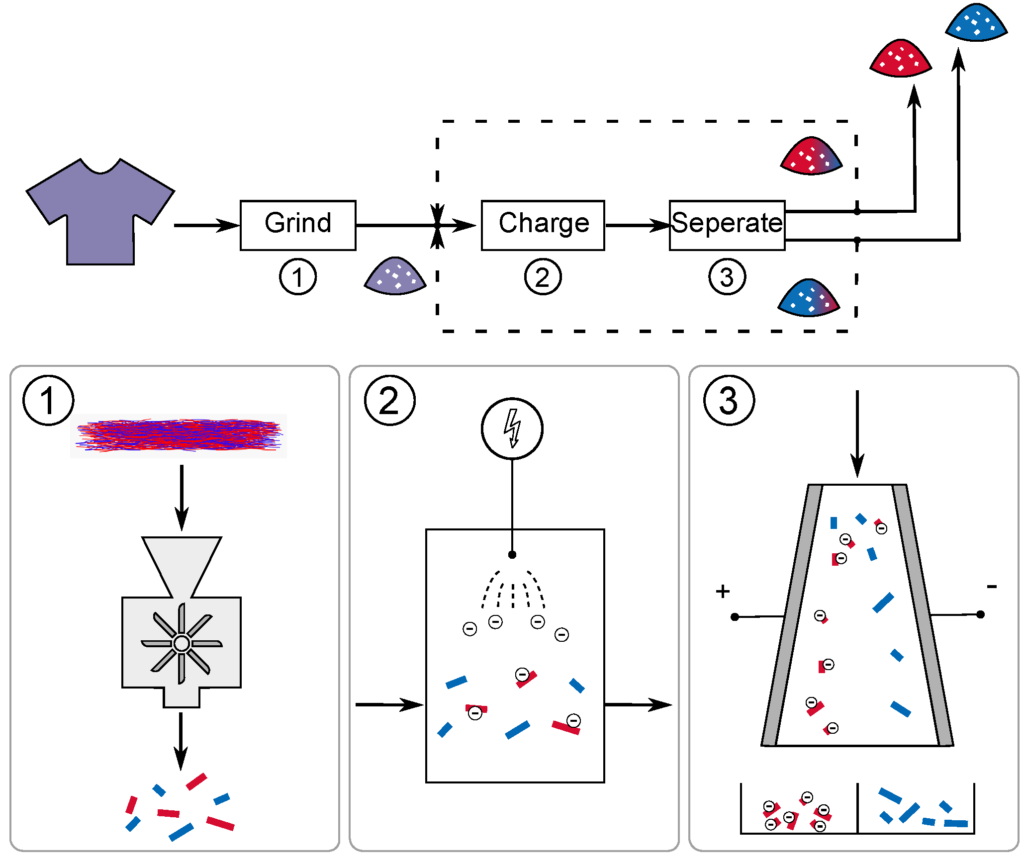
The first step is to grind the textiles. The resulting particles are electrostatically charged and separated from one another using an electric field in the final step. Depending on the required level of purity, these steps can be repeated to obtain pure fractions.
You can download a leaflet with information about the MiGreRe project in either English or German:
The Partners
The research project involves the Center for Environmental Research and Sustainable Technologies (UFT) of the University of Bremen, the Fiber Institute Bremen e.V. (FIBRE), and the Bremen Cotton Exchange (BBB) as cooperation partners.

The Funding Agencies
The MiGreRe Project is co-funded by the European Union and also funded by the Bremen Development Bank (BAB) and the Senator for Environment, Climate and Science of the Free Hanseatic City of Bremen.
For further information or enquiries regarding the project, please contact:
