
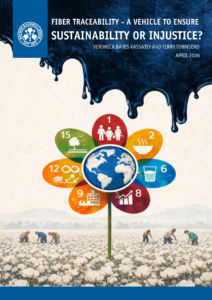
The report is available for download here.
Polyester accounts for almost 60% of all fibre production, while cotton accounts for a little over 20% and wool 1%. Only 12% of polyester is of recycled origin, and 98% of that comes from bottles diverted from the beverage industry. In other words, recycled polyester is just virgin polyester one step removed. Yet nobody traces virgin polyester, and there are no certification schemes for virgin polyester.
In a paper published by the Bremen Cotton Exchange in April 2026, Veronica Bates Kassatly and Terry Townsend examine the justifications behind this approach and assess the consequences for textile and apparel sustainability claims and global legislation.
The report, “Fiber Traceability – a Vehicle to Ensure Sustainability or Injustice?” is a must-read for anyone and everyone in sustainable fashion, particularly those with an interest in legislation and impact claims.
A sample of findings of concern examined in the paper includes the following:
More than 2500 chemicals, 800 of which are known to be highly hazardous, are used, present, or released by the most common form of polyester fibre, PET. In comparison, only 135 highly hazardous chemicals are used worldwide in pesticides applied to cotton. Equally concerning, a further 1,609 chemicals associated with PET have not been tested and so are evaluated as harmless but might be hazardous.
The water footprint of one kilogram of polyester fibre is between 5 and 7 times greater than that of one kilogram of cotton.
One-fifth of all the polyester produced in the world is made from oil or natural gas feedstock that originated in sanctioned countries. By importing polyester in the form of textiles and apparel, countries are facilitating the circumvention of sanctions.
Veronica Bates Kassatly is an independent analyst of sustainability claims in the global apparel sector. A former World Bank economist and analyst, and briefly, the co-owner of a niche fashion brand, Bates Kassatly has co-authored multiple published papers on apparel and fiber impacts as well as green claims and legislation, including four papers with Professor Doro Baumann-Pauly for the Geneva Center for Business and Human Rights, two papers with Dr. Townsend for the Cotton Research and Development Corporation of Australia (CRDC), and most recently, 3 papers with Terry Townsend published by the Bremen Cotton Exchange.

Terry Townsend began his career in agriculture in 1974 as a Peace Corps Volunteer on Saipan in the Western Pacific. He worked at USDA for five years in the 1980s as a cotton analyst. He served as statistician for the International Cotton Advisory Committee (ICAC) for 12 years and executive director for 15 years before retiring at the end of 2013. He remains active in support of natural fibres through membership in the Discover Natural Fibres Initiative, as an author of articles and papers for industry publications, and as a consultant. He has a Ph.D. in Agricultural and Resource Economics from Oregon State University in the United States.
Both authors are available for questions and interviews. The Bremen Cotton Exchange is available to help you get in touch with them.